The Meal You Only Eat If You Know Where to Dock

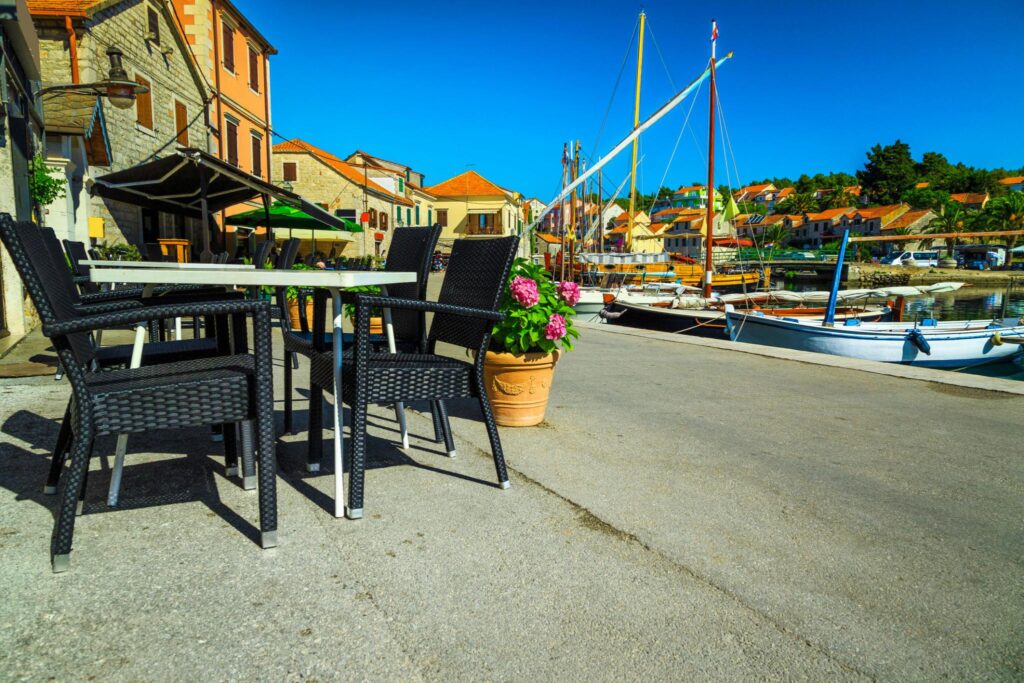
Some of the best restaurants on the Dalmatian coast have no road access. No address in any navigation app. No sign visible from the main tourist path. You reach them by water, or you don’t reach them at all — and this, for the families who have run them for generations, is precisely the point.
The boat-access-only konoba is a category that barely registers in travel media, partly because it resists the logic of search-engine content. You cannot write “how to find” something that communicates through word of mouth and requires a mooring line.
A Geography of Exclusion
Along the Pelješac Peninsula, in the channels of the Kornati archipelago, and in the bays around Šibenik, there are family-run restaurants that seat perhaps twenty to thirty people under pergolas that have been growing into the roof for decades. The menu does not exist in written form. You eat what was caught that morning — whole, grilled over wood, dressed with local oil — accompanied by dishes that have not changed because there has been no external pressure to change them.
According to Visit Dalmatia, the region’s culinary heritage is centred on fish, shellfish, and local produce prepared with minimal intervention. The boat-access konoba is the purest surviving expression of this.
The Pattern Across the Mediterranean
The same phenomenon exists across every serious sailing destination. In Greece, it is the taverna on an uninhabited island that appears on no official map but receives six boats each evening through July. In Montenegro, a restaurant in the Bay of Kotor accessible through a narrow channel that chart plotters sometimes misread. In Turkey, along the Bozburun Peninsula documented by the Turkish Maritime Organisation, family operations in protected bays where the day’s menu depends on what arrived at the nearest market that morning.
What these places share is a relationship with their clientele that volume tourism has made impossible everywhere else. They know, roughly, who is coming. They cook accordingly.
What You Give Up and What You Get
The tradeoff is honest. You cannot spontaneously decide to go to these places. You need a boat — which means chartering one, owning one, or knowing someone. You need to know where to anchor. You need to have done the research, or to have met the right person at the right marina bar the evening before.
Platforms building the water economy’s digital infrastructure — integrated booking for boats, local services, and the businesses around marinas — are slowly creating the conditions where these places might, for the first time, become findable. Whether that changes them is a question worth watching carefully.
How to Find Them
There is no definitive list, and there probably should not be. Book a bareboat or crewed charter in the Šibenik archipelago, the Hvar channel, the Pelješac coast, or the Bay of Kotor. Talk to your skipper on the first evening. Ask specifically about places reachable only by water. The ones worth finding are known to the people who live on it.
FAQ: Boat-Access Dining in the Mediterranean
Are boat-access-only restaurants a real category or just rare exceptions? They are a genuine category across the Mediterranean, particularly in Croatia, Greece, Montenegro, and Turkey. The concentration is highest in archipelago regions where road infrastructure never reached certain bays and coves — and where families chose to remain rather than relocate.
How do you find boat-access restaurants in Croatia? The most reliable method is local knowledge — specifically, asking your charter skipper or marina staff. Sailing community forums and Croatian cruising guides (such as those published by Imray) sometimes document well-known examples, but the most interesting ones are rarely written about publicly.
Do these restaurants accept reservations? Rarely in the formal sense. Some can be contacted by VHF radio when approaching. Others operate on a first-come basis. The implicit reservation is arriving before the other boats.
What should I expect to eat at a Dalmatian boat-access konoba? Typically whole grilled fish (sea bass, sea bream, dentex), octopus salad, local shellfish, bread baked on-site, and local wine or rakija. Menus are dictated by the morning’s catch and the season. Prices are generally modest relative to the experience.
Is this type of dining experience disappearing? Slowly, yes — as coastal real estate values rise and younger generations leave for cities. The ones that survive tend to do so because a family member made a deliberate decision to continue, often supported by a loyal clientele of returning sailors rather than one-time tourists.
Can I reach these restaurants without a sailing licence? Some are accessible by dinghy or small motorboat from a nearby anchorage, which typically does not require a licence depending on engine size and jurisdiction. Others require sailing or motoring to the location, which requires appropriate documentation.