The Night Passage: Why Sailing After Dark Changes Everything You Think You Know About the Sea

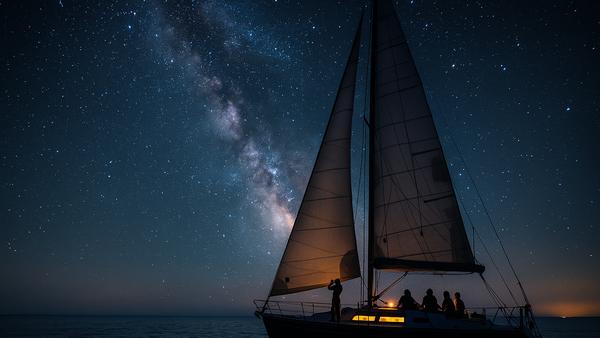
Most sailors remember their first night passage the same way. The coast disappears. The horizon dissolves. The only references left are the compass, the stars, and the sound of water against the hull. Everything you learned about sailing in daylight suddenly feels incomplete.
Night sailing is not simply sailing with less visibility. It is a fundamentally different relationship with the sea — and the sailors who have done it consistently will tell you it is where you learn what kind of sailor you actually are.
What Changes When the Sun Goes Down
During daylight, sailing is largely a visual exercise. You read the water surface for wind, you judge distances by landmarks, you spot other vessels early and adjust accordingly. Remove the light and every one of these inputs either disappears or becomes unreliable.
What replaces them is sensory and instrumental. You feel the wind on your face more acutely. You listen to the rig differently. You trust the instruments — compass heading, GPS track, AIS display — in a way that daylight sailing rarely demands. Experienced offshore sailors consistently report that night passages accelerate seamanship development faster than any equivalent daytime experience.
The Royal Yachting Association includes night sailing as a core competency in its Coastal Skipper qualification for exactly this reason. It is not an advanced optional extra. It is considered fundamental to genuine offshore competence.
The Mediterranean at Night
The Mediterranean offers some of the most accessible night sailing conditions in the world for developing sailors. Summer thermal winds — the Maestral in the Adriatic, the Meltemi in the Aegean — typically moderate after sunset, producing stable, manageable conditions for passages between islands.
The standard approach among experienced Adriatic charterers is to depart for longer passages — Split to Vis, Corfu to Kefalonia, Sardinia to Corsica — in the late evening, sail through the night, and arrive at the destination marina in the early morning before peak berthing competition begins. This is both seamanship and logistics: you sail in calm conditions and arrive before the afternoon crowds.
As we explored in Why the Adriatic Is the Most Technically Demanding Charter Destination in Europe, the Adriatic rewards sailors who understand its rhythms rather than fighting them. Night passages are part of that understanding.
What You Need Before Your First Night Passage
Navigation lights checked and functional. AIS transponder active. Watch system established — never one person alone on deck for more than two hours. Waypoints programmed. Traffic separation schemes identified on the chart. A hot drink prepared.
The preparation is not complicated. The discipline is. Night sailing demands that you do the things experienced sailors do automatically — brief the crew, check the equipment, plan the route — rather than relying on daylight to cover gaps.
Platforms like Marina Smart are building tools that support this kind of passage planning — real-time marina availability so you know your arrival berth before you leave, crew verification so you know who is on deck with you. The infrastructure around the passage matters as much as the passage itself.
Why It Changes You
Sailors who complete their first successful night passage describe a consistent shift in confidence — not overconfidence, but a quiet certainty that they can handle the sea in conditions beyond the comfortable. It is the difference between knowing you can sail and knowing you can navigate.
The sea at night is the same sea. The difference is entirely in the sailor.
FAQ: Night Sailing and Offshore Passages
Is night sailing dangerous for beginners?
Night sailing requires additional preparation and discipline but is not inherently more dangerous than daytime sailing for properly equipped and crewed vessels. The key requirements are functional navigation lights, AIS, a watch system that prevents any single person from being alone on deck for extended periods, and thorough passage planning before departure.
What qualifications do I need for night sailing?
The RYA Coastal Skipper certificate includes night sailing as a core component. Many charter companies require evidence of night sailing experience for offshore passages. The ICC (International Certificate of Competence) does not specifically test night sailing but assumes competence appropriate to the waters being navigated.
What are the best Mediterranean routes for a first night passage?
Shorter island-to-island passages in stable summer conditions are ideal for first night passages — Split to Vis in Croatia (approximately 4-5 hours), Athens to Hydra in Greece, or passages within the Ionian islands. These offer manageable distances with known waypoints and reliable summer weather patterns.
How do you maintain watch during a night passage?
Standard watch systems divide the crew into rotating shifts — typically two hours on, four hours off for smaller crews, or three hours on, six hours off for larger crews. At least two people should always be available, with one actively on watch and one resting but immediately available.
What lights do you need for night sailing?
All vessels under sail at night must display red (port) and green (starboard) sidelights visible for at least two nautical miles, plus a white sternlight. Vessels under power use a white masthead light in addition. Navigation light requirements are defined by COLREGS — the international regulations for preventing collisions at sea.
Does night sailing require special equipment?
Beyond standard safety equipment, night sailing benefits from: a functioning AIS transponder and display, a chartplotter with night mode, a quality compass light, a reliable handheld torch for each crew member, and warm clothing regardless of daytime temperatures. The sea temperature at night is significantly different from the cockpit experience during the day.