The Catamaran Took Over the Mediterranean. Sailors Are Not Happy About It.

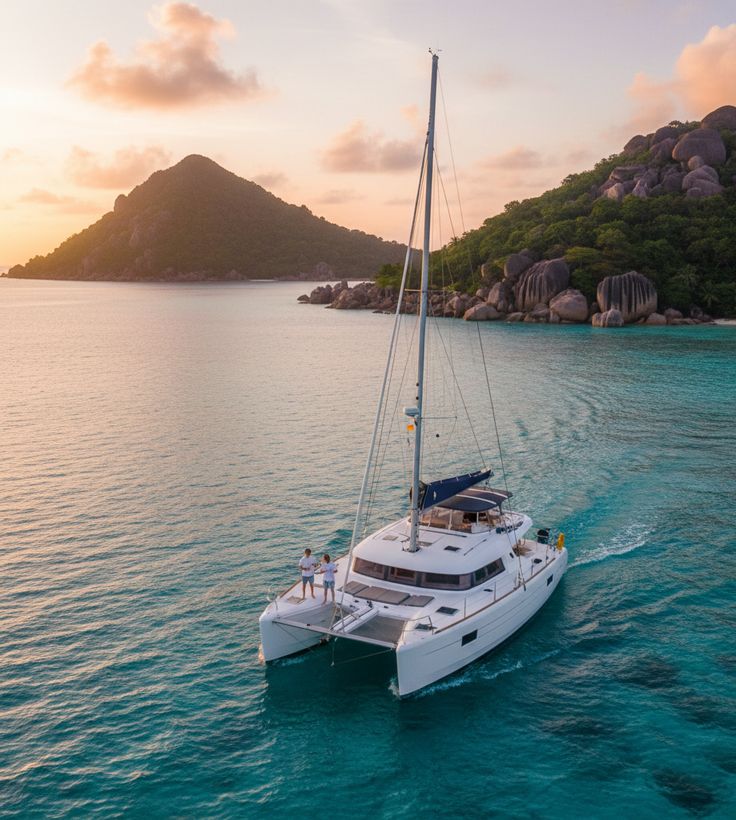
Walk into any marina between Split and Santorini in July and you will notice something that would have seemed strange twenty years ago. The monohulls are still there — elegant, purposeful, quietly tilted at their moorings — but they are increasingly outnumbered. The wide, white, flat-decked shapes now dominate the docks. Two hulls. Generous cockpits. Trampolines stretched over the bows where tanned families eat breakfast in the morning sun.
The catamaran has won.
Not officially. Not on paper. But empirically, undeniably, and to the considerable frustration of a certain kind of sailor — the kind who learned on a monohull, who speaks of heel angle and weather helm with genuine affection — the Mediterranean charter market has made its choice.
How This Happened
It did not happen overnight, and it was not driven by ideology. It was driven by comfort.
The modern charter catamaran offers something a monohull structurally cannot: stability at anchor. When a family drops into a bay on a catamaran, the boat sits flat on the water. Dinner is served on a level surface. Nobody slides across the saloon. The children sleep without gripping the lee cloth. The parents finish their wine.
On a monohull, in any kind of swell — even the gentle, rhythmic kind that the Adriatic produces on a summer evening — none of that is guaranteed.
Charter companies noticed this ten years ago. Guests were returning with the same feedback: beautiful experience, but I could not sleep, and my partner will not come back. The industry responded rationally. They ordered catamarans.
By 2023, catamarans represented more than 60 percent of new charter boat orders across major Mediterranean fleets. The number is still climbing.
What Sailors Are Actually Angry About
The frustration among traditional sailors is real, but it is worth understanding precisely what it is about.
It is not purely aesthetic, though aesthetics are part of it. A monohull under sail — properly trimmed, heeled to the wind, moving through water with the efficiency of a design that has been refined over centuries — is genuinely beautiful in a way that a catamaran, for all its practicality, is not. There is a reason sailing photography still almost exclusively features monohulls.
The deeper grievance is about what the catamaran represents: the transformation of sailing from a skill into an experience. A monohull demands something from you. It has opinions. It pushes back. Learning to sail a monohull well takes years, and that investment creates a relationship with the boat and with the sea that is qualitatively different from stepping aboard a floating platform and pressing autopilot.
A catamaran, critics argue, turns the Mediterranean into a very large, very expensive swimming pool with a dining table.
This is perhaps unfair. Sailing a large catamaran in open water is not trivial. But the critique contains something true: the barrier to entry has dropped, and the profile of who comes to the sea has changed with it.
The New Mediterranean Sailor
The person who books a catamaran charter today is not the person who booked a monohull thirty years ago.
They are younger, on average. They come in groups — friends in their thirties, young families, couples who found each other at a tech company in Amsterdam or a law firm in London. They have disposable income but not necessarily sailing experience. They want the photograph as much as the voyage. They want the bay, the sunset, the dinner on the water. They are not interested in learning to tack.
This is not a criticism. It is an observation about who the sea is for now — and the answer, increasingly, is: for everyone. The democratization of the charter experience, driven partly by the catamaran’s accessibility and partly by the rise of booking platforms that made the process less opaque, has brought an entirely new generation to the water.
Whether that is good for the sea, for the marinas, for the culture of sailing — that is a more complicated question.
What the Industry Has Not Fully Reckoned With
The catamaran’s dominance has created a structural tension that the charter industry has not fully resolved.
Catamarans are wide. Significantly wider than monohulls of equivalent length. A 45-foot catamaran occupies roughly the same dock space as a 65-foot monohull. Mediterranean marinas, most of which were designed and built in an era when monohulls were the norm, were not built for this. Peak season in the busiest Croatian and Greek marinas already resembles a geometry puzzle. As catamaran fleets continue to expand, the infrastructure is quietly approaching its limits.
There is also a pricing dynamic worth watching. Because catamarans accommodate more people comfortably — six to ten guests versus four to six on a comparable monohull — the cost per person drops significantly. This makes them attractive for groups splitting costs, which has accelerated adoption further. Charter companies benefit from higher utilization rates. Marinas benefit from higher occupancy. Everyone benefits, until the marinas are full and the bays are crowded and the experience that made the Mediterranean worth coming to begins to erode.
The Monohull Is Not Dead
It would be a mistake to write the obituary too early.
There is a segment of the charter market — smaller, more discerning, more willing to pay — for whom the monohull remains the only serious option. Bareboat charters for experienced sailors. Blue water passages. Racing enthusiasts. The kind of client who wants to actually sail, not simply be transported by water.
And there is a growing counter-movement among younger sailors — not large yet, but visible — who are choosing monohulls precisely because they are harder. The same instinct that brings people back to film photography and vinyl records and manual transmission cars. The desire for friction. The belief that difficulty is where experience lives.
The sea has always attracted that kind of person. It probably always will.
What This Tells Us About the Mediterranean
The catamaran debate is, at its core, a debate about access versus authenticity — a tension that appears across every industry that gets discovered, scaled, and democratized.
The Mediterranean is not the first beautiful thing to be loved by more people than it was designed for. It will not be the last. The question is not whether to resist that process, which is futile, but how to manage it — how to build the infrastructure, the regulation, and the culture that allows more people to experience the sea without destroying what made them want to come in the first place.
That is a harder problem than choosing between two hulls.
But it starts with understanding that the choice between a catamaran and a monohull is never just about the boat. It is about what kind of relationship with the sea you are looking for — and what kind of sea you want to hand to the next generation.
Marina Smart Journal covers the business, culture, and future of the water economy. Follow us at blog.marinasmart.app