Hurricane Season Is Coming. Most American Boat Owners Are Already Making the Wrong Call.

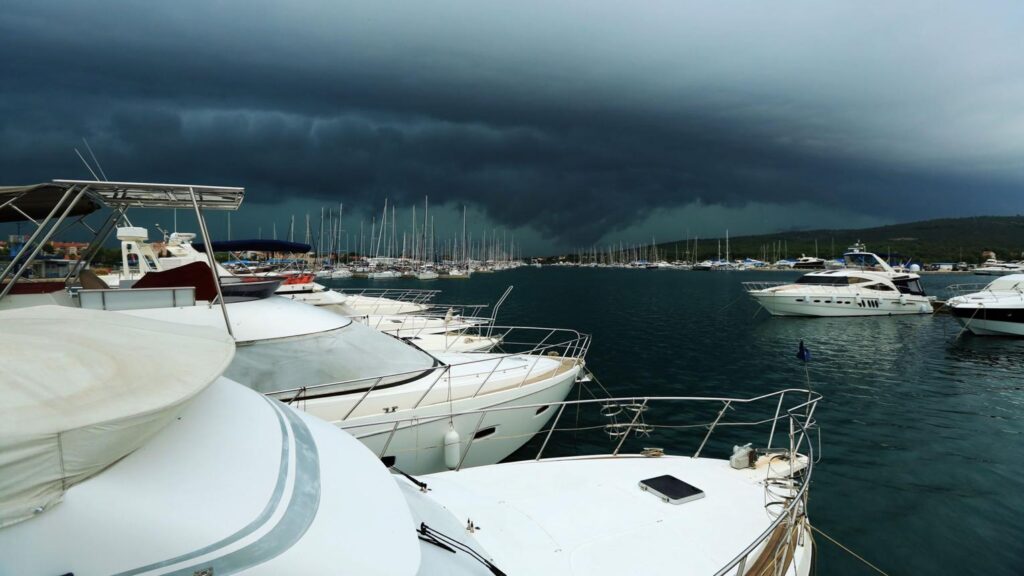
Every year, thousands of boats are damaged or destroyed not by the storm itself, but by decisions made weeks before it ever formed. Here’s what the data actually says about haul-out timing, storage, and risk.
Desk: Nautics · Est. read: 5 min
Atlantic hurricane season runs June through November, and according to NOAA’s National Hurricane Center, the peak threat window for the Gulf Coast, Florida, and the Eastern Seaboard concentrates heavily between August and October. Most boat owners know this. What fewer of them know is how badly the standard advice — “haul out before the season” — fails to match what insurers and marine surveyors actually see after a storm.
The data from major claims, compiled annually by BoatUS through its catastrophe response teams, tells a consistent story: boats lost to hurricanes are disproportionately boats that were left in the water on standard mooring setups, in marinas without storm-rated infrastructure, with owners who had a plan that assumed more lead time than the storm actually gave them.
Why “I’ll haul out when a storm is coming” doesn’t work
The math is unforgiving. A Category 3 storm can form and make landfall within 72 hours. Boatyards across an entire region book out completely within 24–48 hours of a watch being issued — every available lift, every available trailer slot, every available hand on deck. Owners who wait for a forecast before calling their marina are, in practice, competing with every other owner in the region for the same finite haul-out capacity.
This is why the National Marine Manufacturers Association consistently recommends a pre-season plan rather than a storm-triggered one: identify your haul-out yard, confirm your slot, and understand your insurer’s specific named-storm deductible before June 1st, not after a watch is issued.
The boats that survive hurricane season aren’t the ones with the best owners during the storm. They’re the ones with a plan made in April.
What actually determines whether a boat survives
Marine surveyors who inspect post-storm damage consistently point to the same factors. Boats stored on land, properly strapped and blocked, survive at dramatically higher rates than boats left on moorings or even in well-protected marina slips. Storm surge, not wind, causes the majority of total losses — which means location matters more than most owners assume. A marina rated for 100-knot winds can still flood if it sits in a surge zone.
Dock lines matter more than owners think. The standard recommendation from BoatUS calls for doubled lines with chafe protection at every contact point, and significant slack to accommodate storm surge — a boat tied tightly for calm water will tear its cleats out when the water rises six feet.
The insurance conversation nobody has until it’s too late
Standard recreational boat insurance policies often include a separate, higher deductible specifically for named storms — sometimes 1-2% of the insured value, which on a $200,000 vessel means a $2,000–4,000 deductible that owners frequently don’t discover until they’re filing a claim. Reading this clause before the season, not during it, is the single highest-leverage five minutes a boat owner can spend in May.
For owners who charter their vessel commercially — an increasingly common model as platforms like Marina Smart make direct booking accessible to individual operators — commercial marine insurance typically requires separate storm preparedness documentation, and insurers increasingly ask for proof of a written hurricane plan as a condition of coverage. This is a genuinely useful forcing function: owners who charter are required to think about this earlier than owners who don’t.
Frequently Asked Questions
When should I haul out my boat before hurricane season?
Marine industry guidance recommends having a haul-out plan and confirmed yard slot in place before June 1st, the official start of Atlantic hurricane season, rather than waiting for a storm watch. Boatyards typically book to capacity within 24–48 hours of a watch being issued.
Is it safer to keep my boat in the water or on land during a hurricane?
Marine surveyor data consistently shows boats properly stored on land, blocked and strapped, survive hurricanes at higher rates than boats left on moorings or in marina slips, primarily because storm surge and wind-driven wave action cause the majority of in-water losses.
What is a named storm deductible?
A named storm deductible is a separate, typically higher deductible (often 1–2% of insured value) that applies specifically to damage from a hurricane or tropical storm that has been officially named by NOAA, distinct from the standard deductible on a boat insurance policy.
Do I need a written hurricane plan if I charter my boat commercially?
Many commercial marine insurance providers now require documented storm preparedness plans as a condition of coverage for individual charter operators, reflecting the higher liability exposure of commercial vessel use during named storm events.