MARINA NO. 14 · MARITIME JOURNALISM · THE BLUE ECONOMY
Every boat buyer is told the same thing: budget ten percent of the price, every year. Brokers repeat it, forums repeat it, and the people who actually run yachts say it is wrong. We followed the money from a 20-foot RIB to a superyacht to find out what ownership really costs, and where the rule breaks.
In short: The “10 percent rule” is a rough benchmark that originated with 30 to 50-metre motor yachts, and professionals now put realistic annual running costs at roughly 7 to 15 percent of purchase price, depending on size, age and how the boat is used. For small boats, depreciation is usually the biggest cost. For crewed yachts, crew is, at 30 to 45 percent of the budget. And because costs follow size and programme rather than value, an older yacht can cost almost as much to run as a new one.
Ask anyone in yachting how much a boat costs to keep and you will hear a number before you finish the question: ten percent of its value, every year. It is tidy, it is easy to remember, and it is, in the words of Will Christie, founder of the brokerage Christie Yachts, “one of the most repeated rules of thumb in yachting”. Writing in SuperyachtNews in October, he argued that it misleads, because what a yacht is worth and what it costs to run are simply not linked.
He is not alone. The buyers’ guide YachtBuyer says the rule “at best” offers a very rough figure for new yachts. So we went looking for the numbers behind it: official marina tariffs, crew salary surveys, operating data from yacht managers and the cost tables boat dealers publish for first-time buyers.
Where does the 10 percent rule come from?
From a particular kind of boat at a particular time. Foreland Marine, a UK yacht management consultancy, traces the benchmark to motor yachts of roughly 30 to 50 metres and says it has become less reliable as crew wages, insurance, marina fees and regulation have changed.
Its April 2026 analysis, based on its own operating data since 2018 and cross-checked against guidance from the large brokerage houses, puts the industry rule of thumb at 8 to 12 percent and a realistic working range at about 7 to 15 percent. A newer sailing yacht with a modest programme can sit near 7 or 8 percent. An older motor yacht chartering through a Mediterranean summer can pass 12 to 15.
The flaw is structural. A percentage of value assumes that costs fall when value falls. They do not. Christie’s illustration is a 30-metre yacht built for around €10 million that costs roughly €1 million a year to run when new. Ten years later it might be worth €5 million. Its running costs do not halve; they are more likely to rise.
A yacht’s value falls every year. Its crew, its berth and its insurance do not read the depreciation schedule.
What does a small boat really cost?
At the small end the rule fails in the opposite direction. A cost guide by the marketplace Rightboat, republished by BoatTEST, repeats the familiar advice to expect upkeep of around 10 percent of a boat’s value each year. Its own sample budgets for five-year-old boats tell a different story. For a 20-foot RIB it estimates $12,000 a year, of which $4,000 is depreciation and only $1,000 maintenance. For a 35-foot sailboat, $29,500 a year, including $10,000 of depreciation. For a 40-foot sport cruiser, $76,000, including $30,000 of depreciation and $15,000 of maintenance.
In every one of those examples, the largest single line is not repairs, fuel or mooring. It is the money the boat loses simply by getting older, which the same guide puts at 10 to 15 percent in the first year and 30 to 40 percent by year five. For most private owners, that is the cost they never see on an invoice.
How much does a berth cost?
Here, at least, there are official numbers. Cala del Forte, the marina in Ventimiglia on the Italian side of the Monaco border, publishes its 2026 tariff, VAT included. An annual berth for a boat of about 14 metres costs €13,515.60. For 20 to 22 metres it is €25,522.35. Above 24 metres there are no annual contracts at all: a 50-metre yacht pays €917 a day in high season, €17,153 for a summer month, or €74,761 for the winter season from October to April, with water and electricity billed on top.
Location changes everything. Foreland puts an annual home berth for a 40-metre yacht in Palma, Antibes or Genoa at €100,000 to €200,000. YachtBuyer, citing West Nautical, estimates that yachts of 40 to 60 metres can save around 30 percent on berthing by basing themselves in the eastern Mediterranean, on the Italian Adriatic coast or in Montenegro, rather than in the western Mediterranean. We have argued before that the berth is the cheapest thing a marina sells; for owners, it is rarely the cheapest thing they buy.
Why is crew the biggest cost on a yacht?
Because it is the cost that grows with every metre and never depreciates. From around 25 metres, professional crew becomes a necessity, which YachtBuyer says changes running costs significantly. Foreland estimates crew at 30 to 45 percent of the annual budget on a fully crewed yacht, and puts the crew bill for a 40-metre sailing yacht with six to eight crew at €400,000 to €600,000 a year.
The recruitment agency YPI Crew’s 2026 salary guide shows how quickly it climbs. A captain on a yacht under 30 metres earns €5,000 to €6,000 a month. Between 40 and 50 metres, €8,500 to €12,500. Between 50 and 60 metres, €10,000 to €16,000, and between 80 and 100 metres, €16,000 to €23,000. On yachts above 50 metres equal rotation, with time on board matched by equal time off, is standard for captains, which in practice means paying for two.
What are the costs owners forget?
The ones that arrive irregularly. Foreland lists insurance for a sailing yacht valued at €10 million at €80,000 to €150,000 a year and management fees at €3,000 to €8,000 a month. It recommends setting aside 2 to 4 percent of the purchase price every year as a refit fund, on top of running costs, and a contingency of 5 to 10 percent of the operating budget. YachtBuyer reminds buyers of the rhythm of large bills: annual maintenance, a lift-out roughly every two years and a class survey with refit work every five.
So what does a 40-metre yacht cost to run?
We built an illustration from the ranges above for a 40-metre yacht bought for €15 million, the example Foreland uses for the rule of thumb. It is not a quote, and it leaves out fuel and routine maintenance, which depend entirely on how far and how often the yacht moves.
Crew, using Foreland’s range for a 40-metre yacht with six to eight crew, at €400,000 to €600,000. A Western Mediterranean home berth at €100,000 to €200,000. Insurance, scaled from Foreland’s figures at 0.8 to 1.5 percent of value, at €120,000 to €225,000. Management at €36,000 to €96,000. A refit fund of 2 to 4 percent, €300,000 to €600,000. Those fixed lines alone come to between roughly €956,000 and €1.72 million a year, before contingency, before fuel and before a single repair. The 10 percent rule would say €1.5 million.
Which is the point. The rule is not wildly wrong on a new yacht; it is wrong about why. Costs are set by length, crew, programme and home port, and the most effective savings come from changing those. Christie describes a 45-metre Feadship whose new owner moved from two seasons to one, dropped rotational crew and reduced winter crewing, and cut the operating budget by around 40 percent. Charter income can help, he adds, but no buyer should rely on it to make the numbers work.
Ten percent is a conversation starter. The real budget starts with a different question: not what the boat is worth, but what it is going to do.
Frequently asked questions
Is the 10 percent rule for yacht running costs accurate?
Only roughly, and mainly for new motor yachts of about 30 to 50 metres, where it originated. Yacht managers now cite a realistic range of about 7 to 15 percent of purchase price a year, and stress that costs follow size and usage, not value.
What is the biggest cost of owning a yacht?
On a crewed yacht, crew: about 30 to 45 percent of the annual budget, according to Foreland Marine. On small private boats, depreciation is usually the largest single cost, often 10 to 15 percent of value in the first year.
How much does a yacht berth cost in the Mediterranean?
It varies widely. At Cala del Forte in Ventimiglia, the 2026 annual rate for a boat of about 14 metres is €13,515.60, and a 50-metre yacht pays €917 a day in high season. Foreland estimates €100,000 to €200,000 a year for a 40-metre yacht’s home berth in Palma, Antibes or Genoa.
How much does a superyacht captain earn?
According to YPI Crew’s 2026 guide, from €5,000 to €6,000 a month on yachts under 30 metres up to €16,000 to €23,000 a month on yachts of 80 to 100 metres, with equal rotation standard above 50 metres.
How can owners reduce yacht running costs?
By changing the programme rather than cutting maintenance: fewer seasons, less rotational crew, a cheaper home port such as the eastern Mediterranean, and independent management. One 45-metre yacht cut its budget by around 40 percent by moving to a single season.
How we reported this
This investigation draws on SuperyachtNews (Will Christie, 13 October 2026), Foreland Marine (10 April 2026), YachtBuyer (updated 13 November 2023 and 10 August 2026), YPI Crew’s 2026 captain salary guide, Rightboat’s cost guide as republished by BoatTEST (6 October 2025) and the official 2026 tariff of Cala del Forte, Ventimiglia.
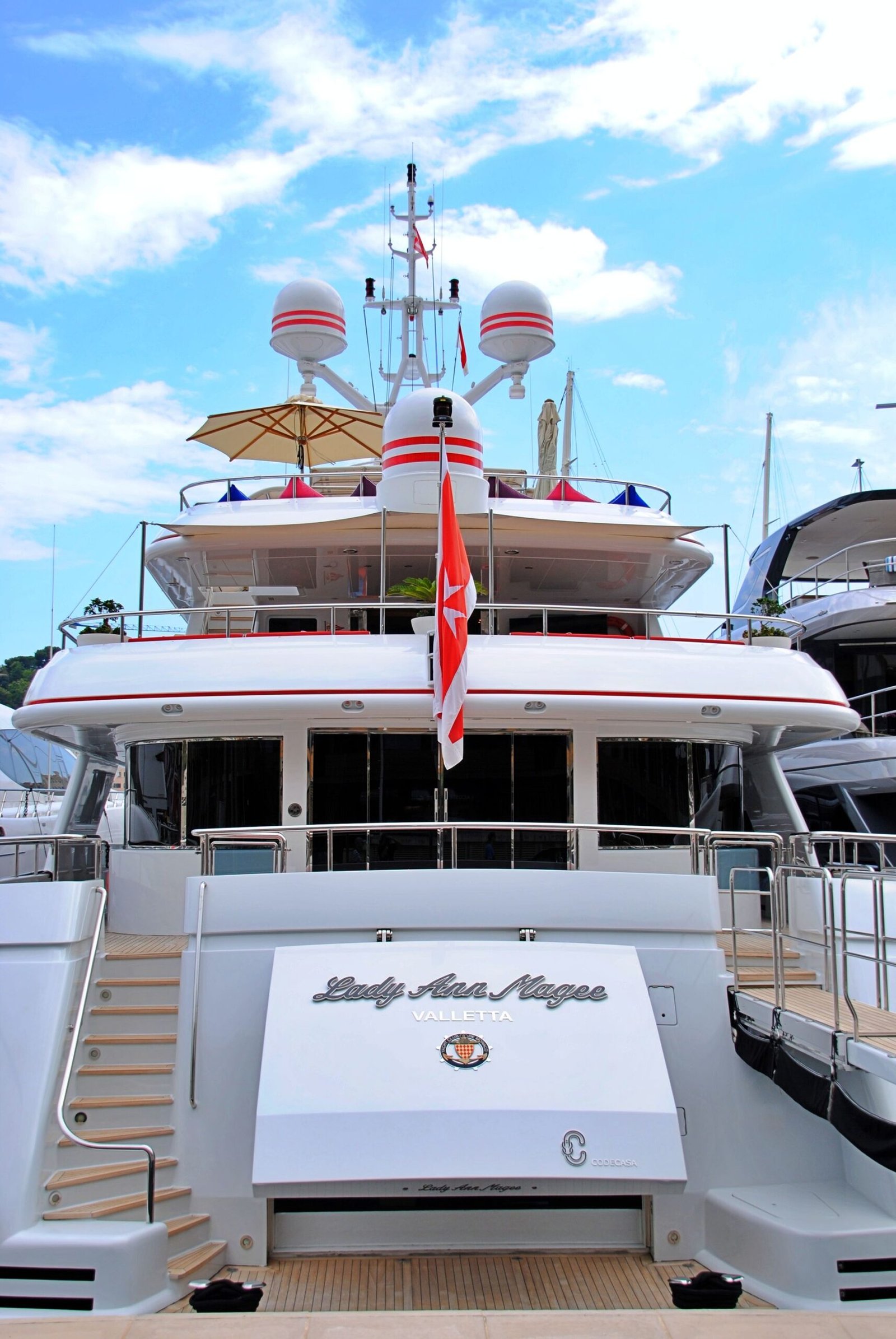
Sources differ in method and currency, and some contain internal inconsistencies, which we note where relevant. The 40-metre illustration is MARINA’s own calculation from the ranges cited and is not a quote or a forecast. Corrections: support@marinasmart.app. Cover photo: A yacht in the harbour of Monaco. Photo: Raouf Meftah / Pexels.


