The Mediterranean charter industry has never been more accessible — or more confusing. Here is what the booking process actually looks like from the inside, and why understanding it changes everything about the experience you end up with.
Desk: How to Charter · Est. read: 8 min
Most people who book a charter for the first time approach it the way they would book a hotel. They compare options, look at photos, check the price, and make a decision based on what the listing tells them. This works reasonably well for hotels because the product is standardised — a four-star room in Dubrovnik is a knowable thing. A charter, even a nominally identical one, is not.
Two people can book the same boat on the same route in the same week and have experiences so different that they would not recognise them as the same product. One comes back describing the best week of their life. The other comes back describing a sequence of frustrations — a boat that did not match its photos, a skipper who had other ideas about the itinerary, a booking process that left them exposed in ways they did not understand until it was too late.
The difference between those two outcomes is almost never about the boat itself. It is about understanding how the charter market actually works — and making decisions accordingly.
A yacht charter is a rental agreement for a vessel, with or without crew, for a defined period. That definition covers an enormous range of experiences, from a two-hour motorboat excursion on the Croatian coast to a twelve-day crewed superyacht itinerary through the Greek islands. The category is less useful than the distinctions within it.
The two most important distinctions are bareboat versus crewed, and direct booking versus broker. Understanding both before you start looking will save you significant confusion — and potentially significant money.
You take the boat and sail it yourself. You will need a recognised sailing licence — in most Mediterranean jurisdictions, an RYA International Certificate of Competence or equivalent — and the charter company will assess your logbook before releasing the vessel. Bareboat is the most cost-efficient way to charter and gives you complete autonomy over your itinerary. It is also the version where your experience and preparation matter most.
The boat comes with a skipper, and often with additional crew such as a hostess or cook depending on the vessel size. You are a passenger. The skipper handles navigation, anchoring, and boat management. Your job is to decide where you want to go and when you want to eat. Crewed charter is suitable for anyone regardless of sailing experience and is the default option for most first-time charterers in the Mediterranean.
The single most important decision in chartering is not which boat you choose. It is whether you understand who you are actually contracting with — and what happens if something goes wrong.
This is where most first-time charterers are most underprepared, and where the gap between a good experience and a poor one is most likely to open.
The Mediterranean charter market operates through three distinct channels, each with different implications for price, protection, and accountability.
You book directly with the person or company that owns and operates the vessel. This is typically the most transparent arrangement — you know exactly who you are dealing with, the contract is with the operator, and disputes are relatively straightforward to navigate. Direct booking is most common in Croatia, where a large number of individual boat owners list their vessels privately, and in Greece, where family-run charter operations often prefer to manage their own bookings.
A broker acts as an intermediary between you and the fleet operator. Reputable brokers, including members of the European Yacht Brokers Association or the MYBA (The Worldwide Yachting Association), add genuine value — they have relationships with operators across multiple markets, they can match your requirements to appropriate vessels, and they have reputational skin in the game. Less reputable brokers operate as simple resellers with no accountability for the product they sell.
Platforms aggregate listings from multiple operators and allow direct booking. The quality of verification and consumer protection varies significantly between platforms. The key questions to ask of any online charter marketplace: Are the boats independently verified? Are client funds held in escrow until after the charter? Is there a structured dispute resolution process? If the answers are unclear, that is information worth having before you pay.
A charter contract is not a hotel booking confirmation. It is a legal document that defines your rights and obligations in considerable detail, and the differences between a well-drafted contract and a poor one matter in practice.
The most important clauses to understand before signing any charter agreement are:
The security deposit. Almost all charters require a security deposit held against damage — typically €1,000–3,000 for a standard sailing yacht, significantly more for larger vessels. Understand exactly what this covers, what the process is for damage assessment, and how disputes about deposit deductions are handled.
The cancellation policy. Charter cancellation policies are generally strict. A booking cancelled 30 days before departure will typically forfeit 50–100% of the charter fee depending on the operator. Travel insurance covering charter cancellation is not optional for anyone who takes this seriously.
The force majeure clause. This defines what happens if the charter cannot proceed due to weather, mechanical failure, or other circumstances outside either party's control. A well-drafted clause protects both parties. A poorly drafted one protects only the operator.
Additional costs. The base charter price rarely covers everything. Fuel, marina fees, provisioning, and the skipper's expenses (known in industry terms as APA — Advance Provisioning Allowance, typically 20–30% of the charter fee on crewed boats) are usually additional. Understanding your true total cost before booking prevents surprises on board.
The word "verified" appears frequently in charter marketing and means very different things depending on who is using it. At minimum, any reputable charter operator should be able to provide: current boat registration documents, valid marine insurance, and safety equipment certification. In EU waters, vessels operating commercially must comply with European Maritime Safety Agency standards, though enforcement varies significantly between member states.
Skipper verification is a separate question. A licensed skipper holds a qualification from a recognised maritime authority — in Croatia, licences are issued by the Croatian Ministry of Sea, Transport and Infrastructure; in Greece, by the Hellenic Ministry of Maritime Affairs. A licence tells you that someone passed an exam. It does not tell you about their experience, their temperament, or their knowledge of the specific waters you will be sailing. Reviews from previous guests are, in practice, the most reliable signal available.
Before booking, most people ask: how much does it cost? What does the boat look like? What is included? These are reasonable questions, but they are not the most important one.
The most important question is: what is my position if this goes wrong?
Specifically: if the boat you booked is not available when you arrive, what happens? If you arrive and find the vessel in significantly worse condition than advertised, what is your remedy? If you paid through a platform and the operator disputes your claim, who arbitrates?
The charter market is not uniformly regulated across Mediterranean jurisdictions, and consumer protection standards vary. Booking through a channel that provides structured dispute resolution and holds funds in escrow until after the charter is not a luxury — it is a basic form of risk management. First-time charterers who do not ask this question sometimes learn its importance the hard way.
The most important question before any charter booking is not what does it cost — it is what is my position if something goes wrong.
The practical sequence for a first Mediterranean charter looks something like this: decide on the type of charter (bareboat or crewed), set a realistic budget including additional costs, choose a departure base that matches your intended itinerary, verify the operator's credentials independently of whatever platform you use to find them, read the contract carefully before paying anything, and confirm your cancellation and insurance position before departure.
None of this is complicated. It is simply more deliberate than booking a hotel — which is appropriate, because the stakes are higher and the product is considerably less standardised. The people who have the best charter experiences are rarely the most experienced sailors. They are the most prepared passengers.
The Mediterranean rewards those who arrive knowing what they are doing. The charter market is no different from the sea in that respect — it has no particular interest in protecting the unprepared.
The peak season charter brochure describes crystal water, available berths, flexible itineraries, and unhurried mornings. These things are true. What the brochure does not mention is that approximately 40,000 other boats have made the same plan, for the same islands, in the same two-week window.
Understanding the real conditions of a Mediterranean high-season charter — before you sign the contract — changes both what you book and what you actually experience.
The Marina Availability Problem
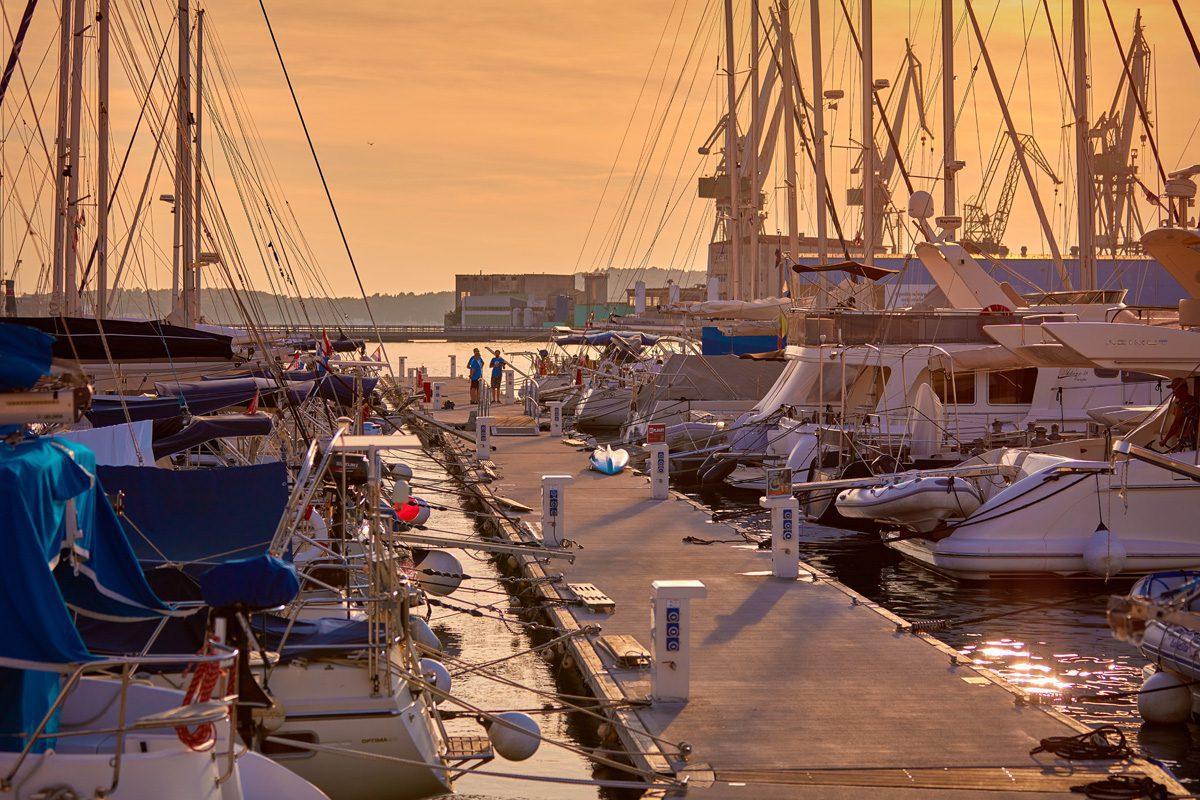
In Croatia, Greece, and the Balearics, the most desirable overnight marina stops in July and August operate at or above capacity from around 4 PM onwards. This is not an occasional inconvenience — it is a structural reality of peak season sailing.
According to the ACI Marina Network, which operates 22 marinas along the Croatian coast, advance berth reservations are strongly recommended during peak season. The informal rule among experienced charterers: if you are not tied up by 4 PM, you are choosing between an undesirable berth, anchoring out, or motoring to the next island as darkness approaches.
What this means in practice: the spontaneous itinerary — "we'll see where we end up each night" — requires either very early arrivals or genuine comfort with anchoring. Both are fine. But not knowing this in advance produces rushed afternoons and frustrated evenings.
Bareboat vs. Crewed: The Distinction Nobody Makes Clearly
The charter industry presents this choice as: bareboat if you can sail, crewed if you cannot. This is incomplete.
The more useful distinction: bareboat if the pleasure is in the sailing itself; crewed if the pleasure is in the destination. These are different experiences using the same vessel.
A bareboat charter requires at least one person with demonstrated sailing competence and the confidence to make weather decisions, manage mooring, and navigate the specific waters you're entering. The Royal Yachting Association and equivalent bodies publish qualification frameworks that most Mediterranean charter companies recognise as minimum requirements for bareboat hire. An honest conversation with your charter operator about your group's actual experience level — before booking — saves significant stress on the water.
A crewed yacht removes these responsibilities and replaces them with a different experience: a local captain managing passages, local knowledge applied to anchorage selection and restaurant recommendations, provisioning handled. The tradeoff is cost and, for some sailors, the loss of the feeling of actually going somewhere rather than being taken.
What "Verified" Actually Means
One of the genuinely confusing parts of charter booking is understanding what verification claims mean in practice. A boat listed as "verified" may mean: the charter company has confirmed it exists. Or it may mean: the vessel has been surveyed within 12 months, carries current insurance, and maintenance records have been reviewed. These are not equivalent.
Similarly, "licensed skipper" has different meanings across jurisdictions. In Croatia, a skipper must hold a skipperska dozvola issued by the Croatian Ministry of Maritime Affairs. In Greece, equivalent documentation is required by the Hellenic Ministry of Maritime Affairs. Asking to see specific licence documentation is not impolite. It is the correct question.
Newer platforms building crew verification into their infrastructure — with background checks, licence confirmation, and genuine review systems — are addressing what has historically been a gap that travellers encounter only after something goes wrong.
The Real Cost of a Charter
Charter prices are quoted as weekly base rates. This number understates the actual cost of the week by 30–50% in most cases.
Additional items typically not included in the base rate: mandatory check-in and check-out fees, end-cleaning charges, security deposit (typically €1,500–€3,000 held on a card for the duration), provisioning, marina fees (€80–€200 per night for a 40-foot boat in peak season in Croatia or Greece), fuel, and — on crewed charters — the APA (Advance Provisioning Allowance), which typically runs 25–35% of the base rate on top.
None of this is hidden. It is disclosed in booking terms that most people do not read carefully enough. Budget honestly and the week remains excellent value. Budget on the base rate alone and the Sunday return becomes stressful.
The number on the charter brochure is not the number you will pay. This is not a scam. It is not fine print designed to deceive you. It is simply how yacht charter pricing has always worked — and nobody explains it clearly before you sign.
The base rate is the starting point. By the time you are untying from the dock on departure day, the real cost of your charter week is typically 40 to 60 percent higher than the number that made you click "enquire now."
Here is exactly what you are actually paying for.
The weekly base rate covers the boat. That is largely it. The vessel, its equipment, and in the case of a crewed charter, the captain's fee is sometimes included — sometimes not, depending on the operator.
What the base rate does not cover, in most standard charter contracts across the Mediterranean, Caribbean, and Southeast Asia:
Mandatory end-of-trip cleaning fee — typically €150–€400 depending on vessel size. Security deposit — €1,500 to €5,000 held on your credit card for the duration of the trip, released after inspection. Check-in and check-out administration fees. Outboard dinghy fuel if applicable. Bed linen and towel rental on some vessels.
These are fixed costs you will pay regardless of where you go or what you do. Budget them before you compare operators.
Marina fees are the single most variable cost in a charter budget and the one most likely to produce genuine surprise.
In Croatia, peak season marina fees for a 40-foot yacht run €80–€180 per night in standard marinas and €200+ in premium ACI network facilities in popular locations like Hvar Town or Korčula. In Greece, comparable figures apply across the Cyclades and Ionian islands. In the Balearics, Ibiza marina fees for larger vessels can exceed €400 per night in July and August.
A week of marina docking — seven nights — can add €800 to €2,500 to your charter cost depending entirely on where you choose to stop.
The alternative is anchoring. Most Mediterranean anchorages are free. Experienced charterers build itineraries that mix marina stops — for provisioning, restaurants, and shore access — with anchoring nights. This is not roughing it. It is how serious sailors travel and it dramatically reduces total cost while often producing the better experience.
Platforms like Marina Smart are beginning to make marina fee transparency easier — with real-time berth pricing and availability integrated into the booking process, so you can plan costs before departure rather than discovering them at the dock.
Fuel is entirely dependent on how you sail. A predominantly sailing trip in good wind conditions on a 40-foot monohull might consume €200–€400 in fuel for the week — primarily motoring in and out of marinas and during calms. A predominantly motoring trip on a catamaran covering significant distance could reach €800–€1,200.
Charter contracts specify fuel policy: almost universally "full to full" — you receive the boat with a full tank and return it full. The cost of refilling is yours.
Check current marina fuel prices in your destination before you go. In Croatia, INA marina fuel prices are published. In Greece, prices vary significantly between islands. Budget conservatively — fuel is the cost most charterers underestimate.
If you are booking a crewed yacht — with captain and crew included — you will encounter the APA: Advance Provisioning Allowance.
The APA is a cash fund, typically 25–35% of the base charter fee, provided upfront to cover running costs during the trip: fuel, marina fees, food, drink, and other expenses. On a €10,000 per week crewed charter, the APA is an additional €2,500–€3,500 on top.
The APA is not profit for the charter company. All receipts are itemised and unused APA is returned at the end of the trip. But it means the real upfront cost of a crewed charter is substantially higher than the quoted base rate.
A realistic budget for a week's bareboat charter in Croatia in peak season, 40-foot yacht, group of six:
Base rate: €3,500. Cleaning fee: €250. Security deposit hold: €2,000 (returned). Marina fees, 4 marina nights: €600. Fuel: €350. Provisioning (food and drink for 7 days, 6 people): €800. One or two restaurant dinners ashore: €300.
Total actual spend: approximately €5,800 — against a quoted base rate of €3,500.
This is not extraordinary. It is typical. The gap between quoted and actual is consistent across operators, destinations, and vessel sizes.
Knowing this in advance does not make the charter less worthwhile. It makes the planning honest — and the experience, as a result, genuinely enjoyable rather than financially stressful.
Most people sign charter contracts after reading approximately none of them. The document is long, formatted in small type, and arrives when the excitement of booking a sailing holiday is at its peak. Reading it carefully feels like looking for reasons to worry.
This is exactly when it matters most. The charter contract is the document that determines what happens when something goes wrong — and something always has the potential to go wrong on the water.
You do not need a lawyer to understand a charter contract. You need to know which seven clauses actually affect your experience and your money.
This clause specifies the amount held on your credit card — typically €1,500 to €5,000 depending on vessel size — and the conditions under which it can be retained. Read specifically: what counts as damage, who assesses it, and what the timeline for release is after return.
The critical detail is the inspection process. A well-written contract specifies that the vessel is inspected at check-out in your presence and that any damage must be documented at that moment. Contracts that allow damage claims to be raised after you have left the marina are structurally unfair and worth querying before signing.
As we covered in The Hidden Costs of Renting a Yacht That Nobody Puts in the Brochure, the security deposit is one of the most significant financial elements of any charter that the base rate obscures.
There are three standard templates in Mediterranean charter — flexible, moderate, and strict — but operators write their own variations. The key numbers: what percentage is refunded if you cancel 90 days out, 60 days out, 30 days out, and within two weeks of departure.
The asymmetry that surprises most charterers: operator cancellation clauses are typically far more generous to the operator than guest cancellation clauses are to the guest. If the operator cancels — due to maintenance, sale of the vessel, or other reasons — the standard remedy is a full refund or substitute vessel, not compensation for your non-refundable flights and accommodation.
This clause specifies what happens in events outside either party's control — extreme weather, port closures, civil disruption. Post-pandemic contracts have become significantly more detailed here. Read specifically whether weather-related inability to sail counts as force majeure or falls under standard cancellation terms.
The RYA's consumer guidance recommends that charterers purchase trip insurance that specifically covers weather-related cancellation separately from the contract's force majeure provisions, since most charter contracts do not provide refunds for poor weather that falls below severe warning thresholds.
For bareboat charters, this clause specifies the minimum qualifications required to take the vessel. Read it carefully against your actual certifications. Misrepresenting qualifications is both legally and practically dangerous — if an incident occurs and your qualifications do not match the contract requirements, your insurance coverage may be void.
This connects directly to the crew verification gap in the current charter market that platforms like Marina Smart are working to address — structured qualification verification at the booking stage rather than a self-declaration form signed at check-in.
Most charter contracts restrict the vessel to a defined geographic area. Sailing outside this area — even briefly, even in an emergency that takes you across a maritime border — can void your insurance and expose you to liability for the full vessel value.
In Croatian waters, the operational area typically covers Croatian territorial waters only. Crossing to Montenegro, Albania, or Italy requires either a specific cross-border permit or a separate contract provision. Verify this before planning any itinerary that approaches international borders.
Understand precisely what the vessel insurance covers and what it does not. Standard charter insurance covers hull damage above the deductible (which is often equivalent to the security deposit). It does not cover personal belongings, personal injury in most cases, or third-party liability above specified limits.
The clause to read specifically: what is the deductible, who is responsible for it, and whether a damage waiver option exists to reduce your exposure. Many operators offer a daily damage waiver fee — typically €20-50 per day — that reduces the deductible significantly. Do the maths before declining it.
This is the most practically important clause for your actual experience. Charter contracts specify fixed check-in and check-out times — typically check-out by 9AM and check-in from 5PM on the same day. The turnaround window is when the vessel is cleaned, inspected, and prepared.
Arriving late for check-in or departing late for check-out has financial consequences specified in the contract. Know these numbers before your trip. As we noted in What Charter Companies Don't Tell You When You Book a Boat in July, the Sunday afternoon changeover is one of the most operationally intense moments in the charter calendar — being the cause of delay has real consequences for the operator and documented financial penalties for you.