MARINA NO. 14 · MARITIME JOURNALISM · LIFESTYLE
On a snowy night in November 1944, a German submarine put two spies ashore in Maine. They were caught, tried, sentenced to death, spared, and lived into old age. Four days after landing them, the same submarine sank the steamship Cornwallis with 43 men. This summer, divers finally found her, 122 metres down. One story was told for eighty years. The other is only now being told.
In short: The SS Cornwallis, a 400-foot (122-metre) Canadian steamer, was torpedoed by the German submarine U-1230 off Maine on December 3, 1944; 43 of the 48 people aboard died. In July 2026 the Nomad Exploration Team, a volunteer dive group, located the wreck near Mount Desert Rock in about 400 feet (122 m) of water, ending a search that began in 2019. Four days before the sinking, U-1230 had landed two spies, William Colepaugh and Erich Gimpel, on the shore of Frenchman Bay.
The snow was falling when a small boat rowed by two German sailors touched the shore of Frenchman Bay on the night of November 29, 1944. Two men stepped out in city clothes, without topcoats or boots, and walked up through the Hancock woods to Route 1. One was William Colepaugh, an American who had defected to Germany. The other was Erich Gimpel, a German engineer. They carried $60,000 in American currency and a packet of 99 small diamonds, according to HistoryNet’s account of the operation the Germans called Elster, Magpie.
Maine noticed them almost at once. Harvard Hodgkins, a 17-year-old Boy Scout driving home from a dance, saw two men walking in the snow “in such light clothes,” and later followed their footprints back to the water. Mary Forni, 29, coming home from a card game, saw them too; Mainers, she said later, didn’t walk in that snow without boots, as the Bangor Daily News recounted. The men took a taxi 35 miles to Bangor and then trains to Portland, Boston and New York.
Out in the Gulf of Maine, U-1230 waited.
What was the SS Cornwallis?
A working ship with a stubborn life. She was built in Vancouver by J. Coughlan & Sons and delivered in 1921 as Canadian Transporter, then renamed Cornwallis in 1932 when she passed to Canadian National Steamships, according to The Maritime Executive. In September 1942 a German submarine, U-514, torpedoed her at anchor in Carlisle Bay, Barbados. She settled in shallow water, was raised, and spent nearly a year under repair before returning to service in August 1943.
On November 20, 1944 she left Barbados for Saint John, New Brunswick, with sugar and molasses. She had 48 people aboard, including seven armed guards, and sailed without an escort, through the Cape Cod Canal and up the New England coast.
How did the Cornwallis sink?
Quickly. On December 3, U-1230 put a torpedo into her near the forward hold. She went down by the bow in less than ten minutes. Six men reached a lifeboat that broke free as she sank. A fishing vessel found them; one had died of hypothermia. The five survivors were transferred to a US Navy ship and landed at Rockland, Maine. Forty-three people were lost.
The spies became a story. The forty-three became a footnote to it.
What happened to the Nazi spies landed in Maine?
They lasted less than a month. On December 21 Colepaugh walked out with both suitcases of money. Two days later he told an old prep-school friend in Queens what he had done, and the friend urged him to turn himself in. The FBI arrested him on December 26. Using his description, agents picked up Gimpel on December 30 at a Times Square newsstand that sold Peruvian newspapers. A military commission sentenced both men to hang. After Franklin Roosevelt’s death and Germany’s surrender, Harry Truman commuted the sentences to life imprisonment.
Gimpel was paroled in 1955 and deported to West Germany; he later wrote a memoir and is reported to have died in Brazil in 2010. Colepaugh was paroled in 1960, settled in Pennsylvania and volunteered with the Boy Scouts. He died in 2005. Harvard Hodgkins went on to Maine Maritime Academy, became a chief engineer in the merchant marine and later ran a lobster pound in Hancock. He died in 1984, at 57.
That is the version Maine has told for eighty years: the snow, the light shoes, the boy who followed the tracks. It is a good story. It is also the story of the survivors of U-1230’s patrol, not of its victims.
Who found the Cornwallis wreck, and where is it?
The Nomad Exploration Team, a self-funded group of volunteer divers based in Portsmouth, New Hampshire, began looking in 2019. Archival research narrowed the search to three areas, and the team surveyed more than 50 square miles (129 km²) with side-scan sonar over five expeditions, Gizmodo reported. On July 11, 2026 a target appeared near Mount Desert Rock, about 25 miles (40 km) off the Maine mainland. Divers descended nearly 400 feet (122 metres), into water around 42°F (6°C), and matched what they saw to the ship’s plans.
“Very quickly we discovered why it had not been found,” Danny Allan, a founding member, said in a video update. His teammate Jeff Goodreau called the conditions “pretty much the worst-case scenario as far as diving goes” to the Portland Press Herald. At that depth, every minute on the wreck costs a long, staged ascent; it is technical diving at its limit, done here without sponsorship. “For the families and communities connected to the ship,” Allan said in a statement, the find “brings renewed attention to a largely forgotten tragedy.” The team plans to return with a remotely operated vehicle.
Why does a wreck like this matter?
Because the sea keeps the record that people let go of. The Cornwallis was not famous. She carried sugar, not troops, and her loss came in the last winter of a war that had already produced thousands of sinkings. Her crew had no novel and no film. What survived of them was a casualty list and the memories of five men landed at Rockland, until a group of divers decided that an unglamorous ship deserved the same patience as a celebrated one.
The wreck is also a grave, and should be treated as one. Most divers will never reach 122 metres, and that is as it should be. For the rest of us, the discovery offers something simpler: the reminder that every famous maritime story has a quieter one beside it. This week, while MARINA wrote about a liner sunk deliberately to become a reef that divers will pay to visit, a team in New Hampshire was making sure an ordinary freighter would be remembered for free.
Frequently asked questions
When was the SS Cornwallis sunk?
On December 3, 1944, by the German submarine U-1230 in the Gulf of Maine. She sank in under ten minutes; 43 of the 48 people aboard died, and five survivors were landed at Rockland, Maine.
Where is the SS Cornwallis wreck?
Near Mount Desert Rock, about 25 miles (40 km) off the Maine coast, in roughly 400 feet (122 metres) of water. The Nomad Exploration Team located and identified it in July 2026.
Who were the Nazi spies landed in Maine in 1944?
William Colepaugh, an American defector, and Erich Gimpel, a German engineer, landed from U-1230 on the shore of Frenchman Bay on November 29, 1944. Both were arrested in New York in December 1944, sentenced to death, and had their sentences commuted to life imprisonment.
Can you dive the Cornwallis wreck?
Only at the limit of technical diving. At about 122 metres in cold water with strong tidal currents, it requires specialist training, mixed gases and long decompression. The wreck is also the grave of 43 people.
What is Legal Smart Journal, MARINA’s partner magazine?
Legal Smart Journal (legalsmart.media) is an international legal-science magazine published by Vuk Bilić, the publisher of MARINA. It connects law, evidence, medicine, science and human rights, and follows each story from prevention to protection and justice, including what people and communities can do to protect themselves in war and crisis. MARINA supports it as its partner publication.
How we reported this
The ship’s history and the sinking come from The Maritime Executive, Gizmodo (citing the Portland Press Herald, the Bangor Daily News and the dive team), and New Hampshire Public Radio.
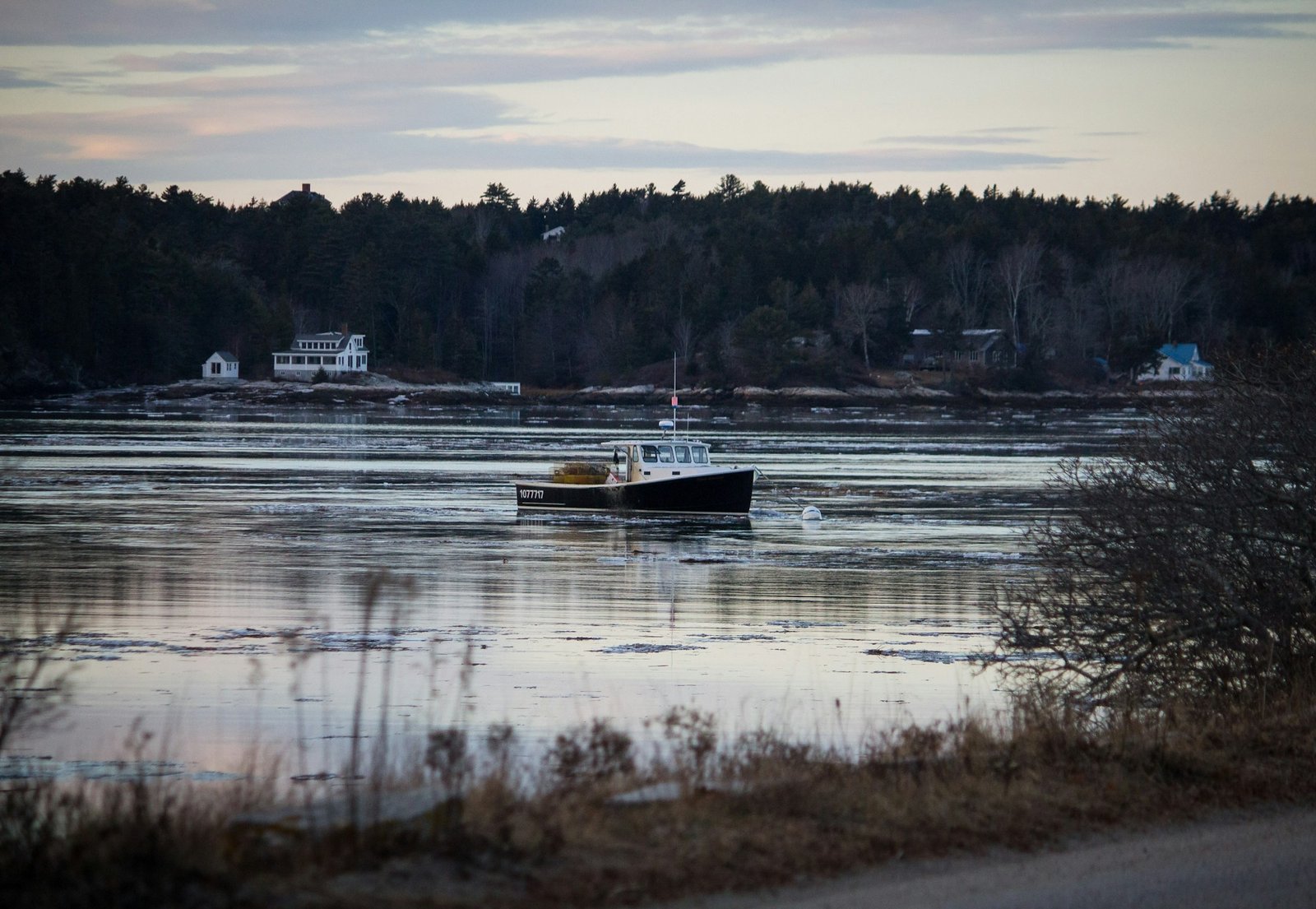
The spies’ landing, flight and arrests come from HistoryNet, the Bangor Daily News and the US Navy’s 1945 interrogation report on Gimpel and Colepaugh; later lives come from the Bangor Daily News, and Gimpel’s death in Brazil is as reported, not confirmed. Accounts differ on small details such as tonnage. MARINA contacted no party directly. Corrections: support@marinasmart.app. Cover photo: A boat on a grey winter sea. Photo: Bonnie Kittle / Unsplash.


