MARINA NO. 14 · MARITIME JOURNALISM · NAUTICS
Sometime before dawn on November 6, a pianist went over the side of a Royal Caribbean ship off Southern California. Around noon, two men returning from a marlin trip saw a head in the water. In between lay about nine hours, a stretch of ocean some 30 kilometres from shore, and a law that has asked cruise ships for sixteen years to detect a fall “to the extent that such technology is available.”
In short: A crew pianist from Ovation of the Seas survived about nine hours in the Pacific after falling overboard on November 6, 2026, and was found by recreational fishermen, not by the ship. US law has required cruise ships since 2010 to use technology that captures images of, or detects, people who fall overboard, but only where it is “available.” The Coast Guard never finished the rules, and most ships rely on cameras that record a fall rather than raise an alarm.
Sean Norton and Grant Garrett had been fishing for marlin off Catalina Island and were heading home to Newport Beach when one of them saw something that did not belong. “Yeah, it’s a human being,” Garrett recalled. “Stop the boat; let’s get all of our lines in.” They each took an arm and hauled the man aboard. According to Norton, he said only two things: thank you, and that he had thought he was going to die, as Cruise Hive reported from the rescuers’ accounts to CBS Los Angeles.
The man was a pianist on Ovation of the Seas, a 168,666-ton ship returning to Los Angeles from a four-night cruise to Catalina and Ensenada. Newport Beach lifeguards estimated that he went into the water at about 2:30 a.m. He was found about 24 to 32 kilometres (15 to 20 miles) off the coast, treading water.
The ship had docked that morning and its passengers had walked off at the usual time. Royal Caribbean said it was supporting its employee and, citing his privacy, gave no further details. The US Coast Guard is investigating how he went overboard and has said he is expected to recover.
He was lucky in a way he could not have arranged. Norton estimated the water at about 76°F (24°C) and said that in another year, without the warm water of an El Niño autumn, the man would not have survived.
How often do people fall off cruise ships?
Rarely, measured against tens of millions of passengers, and with grim consistency. A 2020 analysis commissioned by Cruise Lines International Association (CLIA), the industry body, counted 212 overboard incidents between 2009 and 2019, about 19 a year, according to Business Insider’s review of the data. Fewer than one in four of those people were recovered alive. CLIA says the vast majority of cases involve reckless behaviour or an intentional act, and the industry points out that ship rails must by law stand at least 42 inches (1.07 metres) high.
That framing is accurate and incomplete. Whatever the reason a person goes over, the first minutes decide whether they live. A ship at cruising speed covers several hundred metres a minute. The longer it takes anyone to notice, the larger the search box becomes and the colder the person gets.
A camera can show where a person went over. It cannot tell anyone that they have.
Are cruise ships required to have man overboard detection systems?
Only conditionally. The Cruise Vessel Security and Safety Act of 2010 says a vessel “shall integrate technology that can be used for capturing images of passengers or detecting passengers who have fallen overboard,” to the extent that such technology is available. The wording sits in 46 U.S. Code § 3507 today.
The word that matters is “or.” The Coast Guard has read the law as letting operators choose between capturing images, which ordinary CCTV does, and detecting a fall, which requires systems such as thermal cameras or radar that raise an alarm in real time. A rulemaking the Coast Guard opened in 2015 stalled after commenters questioned whether detection technology was reliable. When Business Insider examined the question in 2023, the agency said it did not enforce either option and had not inspected ships for overboard technology in more than a decade. We found no final rule since.
Does man overboard detection technology actually work?
An international standard exists. ISO published requirements for overboard detection systems in 2020: a 95 percent detection rate and no more than one false alarm a day. In 2023 the Coast Guard told Business Insider it knew of no product that met that standard. One supplier, MARSS, said its MOBtronic system had succeeded in 120 tests and cost about $500,000 per ship; those are the company’s own figures.
The industry’s position is that the systems are not yet good enough. Carnival told Business Insider that detection systems were “still unreliable,” and that it is “virtually impossible to fall off a cruise ship without a purposeful action to climb up and over safety rails.” Critics answer that the incentives point the other way. “There’s no financial consequence when someone goes overboard to the cruise line,” the maritime lawyer Jim Walker told the publication. US taxpayers fund Coast Guard searches, and the Death on the High Seas Act of 1920 limits what families can recover for deaths far from shore.
Is Congress changing the law?
A bill would. The Cruise Passenger Protection Act of 2025, introduced by Senators Richard Blumenthal and Edward Markey on August 1, 2025, would change “or detecting” to “and detecting,” and require the systems to be certified by an independent third party accepted by a classification society. The latest action in the congressional record we checked was its referral to the Senate Commerce Committee on the day it was introduced.
What should change?
The argument about whether a sensor is 95 or 99 percent reliable has run for a decade, and it has obscured a simpler question: who is responsible for noticing that a person is missing? On November 6 the answer was two fishermen who happened to be looking at the right patch of sea. No one has said publicly when the ship realised its pianist was gone, and the Coast Guard has not released its findings. Until it does, MARINA will not speculate about this case.
The wider point does not depend on it. A ship can carry thousands of people, a theatre, a casino and a dozen restaurants, and still rely on a person looking at a screen, or a roll call hours later, to learn that someone has gone into the dark. The technology question is real. So is the decision, renewed every year, to treat it as optional.
For passengers, the practical advice is unglamorous: never sit on or climb a rail, look after friends who have been drinking, and if you see anyone go over, shout “man overboard,” throw anything that floats, keep pointing at the person and get the nearest crew member to call the bridge. The first minute is worth more than any sensor. The same rule holds on a chartered yacht, where our guide for first-time charterers covers safety on deck.
Frequently asked questions
What happened on Ovation of the Seas in November 2026?
A crew member who worked as a pianist fell overboard, at about 2:30 a.m. on November 6, 2026 according to Newport Beach lifeguards’ estimate, as the ship sailed back to Los Angeles. Two fishermen found him alive about nine hours later, 15 to 20 miles (24 to 32 km) off the Southern California coast. The Coast Guard is investigating.
How many people go overboard from cruise ships each year?
An industry-commissioned analysis for CLIA counted 212 overboard incidents from 2009 to 2019, an average of about 19 a year. Fewer than a quarter of those people were rescued alive.
Do cruise ships have man overboard detection systems?
Some do, but most comply with US law using CCTV that records images rather than systems that detect a fall and sound an alarm. The 2010 law lets ships use either, to the extent the technology is available.
Can you survive falling off a cruise ship?
Sometimes. Survival depends on the height of the fall, injuries, water temperature, sea state and, above all, how quickly anyone raises the alarm. Fewer than one in four people who went overboard in 2009 to 2019 were recovered alive, according to the CLIA analysis.
How we reported this
Details of the rescue come from the rescuers’ and Newport Beach lifeguards’ accounts as reported by CBS Los Angeles and summarised by Cruise Hive and Faithwire on November 8 to 10, 2026; Royal Caribbean and the Coast Guard released no further details. Legal text is from 46 U.S.C. § 3507 and the Senate bill text of the Cruise Passenger Protection Act of 2025; the bill’s status is from the congressional bill-status record.
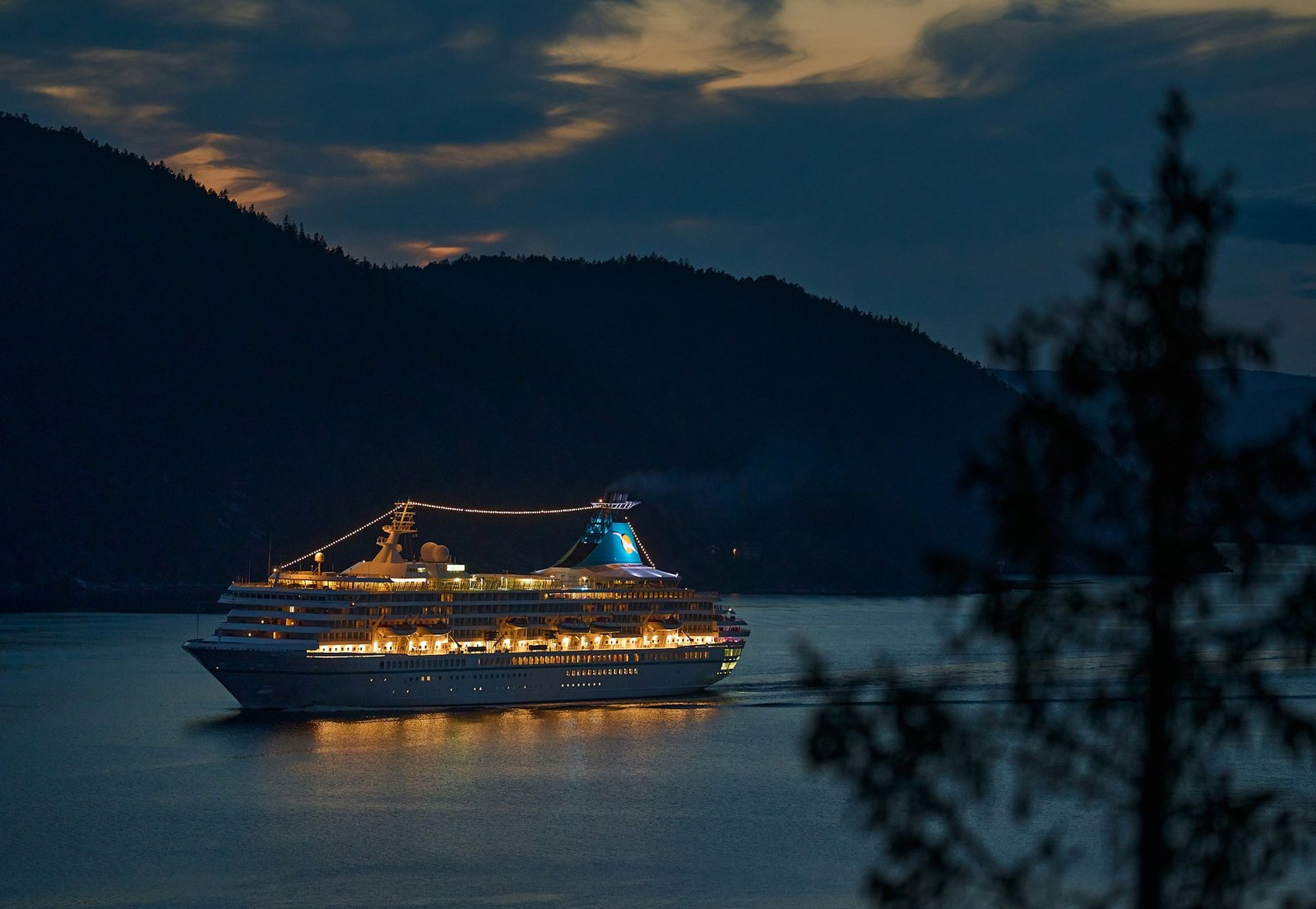
Overboard statistics, the ISO standard, Coast Guard enforcement and company statements come from Business Insider’s 2023 investigation, which cites CLIA’s 2020 analysis; we have not seen the underlying CLIA report. MARINA contacted no party directly. Corrections: support@marinasmart.app. Cover photo: A cruise ship at night. Photo: Vidar Nordli-Mathisen / Unsplash.


